








Valentine’s Day has come and gone, and Cupid’s arrows appear to have missed most Bentley University students.
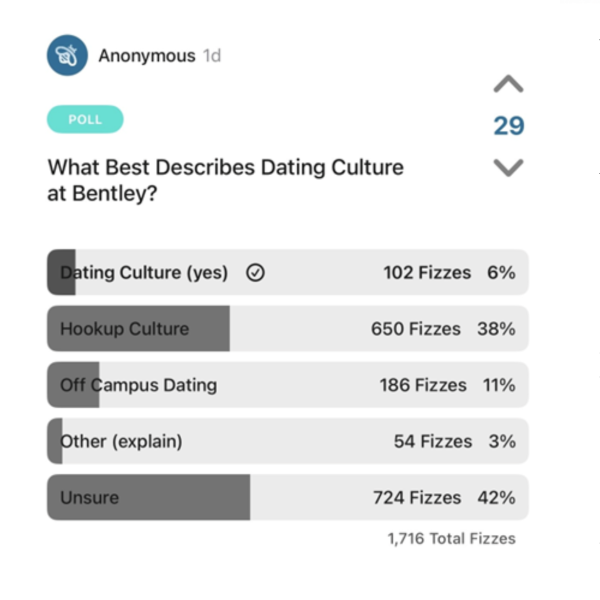
More than one-third of respondents in a Vanguard poll conducted on Fizz said the campus has a hookup culture. The largest group, at 42%, reported being unsure how to label it. Even more surprising, only 17% of students say there is a dating culture on or off campus. The results indicate that while casualrelationships are common on campus, expectations are often unclear and difficult for students to navigate.
Sophomore Tobias Larsen described Bentley’s dating culture as “pretty casual and sort of messy sometimes.” He said the university’s small size can make dating feel less private. “Since Bentley is so small, everyone knows each other, so dating never really feels private,” Larsen said.
Larsen further noted that the poll results were unsurprising. “Everyone has different expectations on how they would prefer to date, but no one really talks about them.” He then goes on to say that this lack of communication leads to “a lot of talking stages and hooking up instead of actually going out on dates.”
When you don’t open up with your partner, it can make it difficult to understand each other’s intentions. “It’s hard being in college and knowing if the other person is just with you for a simple hookup or if they want anything else,” Larsen said.
When asked about serious dating at Bentley, he said, “It would take time and a lot of commitment,” noting that “both partners need to feel the same wayfor it to really be something serious.”
According to Larsen, avoiding labels and commitment is common on campus, particularly among underclassmen. “There is this norm that not caring and being chill about it is better than admitting how you actually feel,” he said.
Sophomore Maddie Krepelka shared a similar perspective, describing Bentley’s dating culture as unclear and informal. “A lot of interactions stay in the ‘talking’ or casual phase rather than turning into defined relationships,” she said.
Krepelka added that students tend to hesitate to explain their emotions. “Students often hesitate to communicate directly, which can lead to mixed signals, and even when people know what they want, they hesitate to say it,” she said.
Both students said that Bentley’s social environment adds another layer of complexity. Larsen said, “I find it easy to meet people in some way, but it’s hard to figure out what the other person really wants.” Krepelka pointed to overlapping social circles as a contributing factor. “Because Bentley is asmaller school, social circles overlap a lot, especially within athletic teams, which can make things feel more complicated,” she said.
When asked to label Bentley’s dating culture, both students used similar language. Larsen described it as “very situationship-central,” adding that “everyone is talking, no one’s dating.” Krepelka referred to it as a “situationship-focused” culture, where connections exist but are rarely clearly defined.
Together, the poll results and student accounts suggest that understanding relationships at Bentley often requires patience, clearer communication, and awillingness to manage uncertainty.